
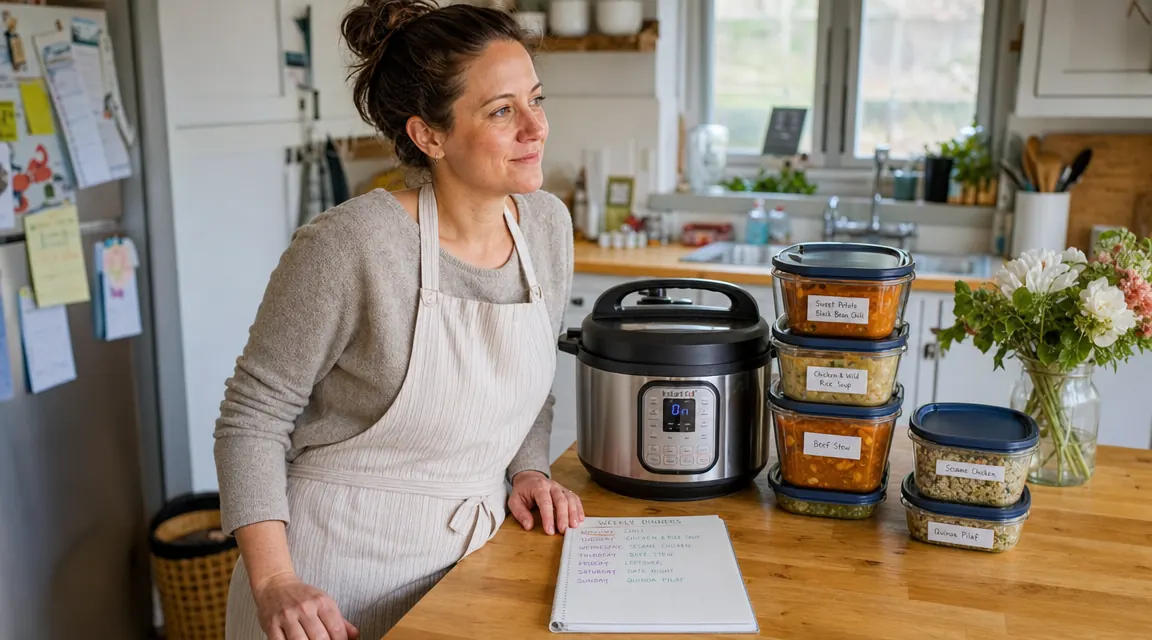
Sunday used to be the day I dreaded most. Not because of the weekend ending, but because I knew that by Tuesday I would be standing in front of the refrigerator at 6 p.m. with nothing thawed, nothing planned, and two kids asking what was for dinner. I tried the whole 'wing it every night' approach for years. It works exactly as well as you think it does.
The Instant Pot Duo 7-in-1 changed that completely, but not in the way I expected. It is not just about cooking one meal faster. It is about using one Sunday afternoon to set up five weeknight dinners at once, so that Monday through Friday you are just reheating and assembling, not cooking from scratch when everyone is already tired and hungry. This guide walks through exactly how I do it, step by step, with real meal ideas and real timing that works for a family of four.
Still cooking from scratch every single night? The Instant Pot Duo makes Sunday batch cooking fast enough to actually stick to.
With 184,000+ reviews and a 4.7-star rating, the Instant Pot Duo 7-in-1 is the meal prep tool most busy families eventually land on. Check today's price and see why.
Amazon Check Today's Price on Amazon →Before You Start: What You Need and How to Think About This
You do not need a fancy meal plan. You need a protein, a grain, a vegetable, and a soup or stew. Those four components will cover most of your weeknight plates. Think of the Instant Pot as your engine for the two items that take the longest: the protein and the soup. Rice and lentils can run at the same time using the pot-in-pot method. Vegetables roast in the oven while the pot is running. You are not trying to cook finished plated meals ahead of time. You are building components that remix easily.
For a family of four, I shoot for: 3 lbs of chicken thighs or a chuck roast, 3 cups of dry rice or farro, 1 cup of dry lentils, and a big pot of soup or chili. That covers Monday and Tuesday as full dinners with leftovers, and Wednesday through Friday becomes mix-and-match assembly. My kids eat the same three to four things all week without noticing because the sauces and sides change.
Step 1: Start With Your Protein, It Takes the Longest to Cool
Put 2 to 3 pounds of boneless chicken thighs in the Instant Pot with one cup of chicken broth, a teaspoon of salt, half a teaspoon of garlic powder, and a bay leaf. Lock the lid, set the valve to sealing, and pressure cook on High for 15 minutes. When the cook time ends, let it natural release for 10 minutes, then quick release the rest. The chicken will be falling apart and shred in about two minutes with two forks.
Why chicken thighs instead of breasts? Thighs stay moist even after reheating, which matters a lot when food is going in and out of the fridge all week. Chicken breasts can turn rubbery by Thursday. The broth left in the pot after shredding is liquid gold. Save every drop. You will use it for the soup in Step 3.
If your family prefers beef, a 2-pound chuck roast at High pressure for 60 minutes with natural release gives you tender shredded beef for tacos, rice bowls, and sandwiches. Same concept, just longer cook time. Plan that one first so it runs while you prep everything else.
Step 2: Cook Grains Using the Pot-in-Pot Method
While the chicken shreds and cools, rinse three cups of long-grain white rice and put it in a stainless steel bowl or a 7-inch cake pan with the standard 1:1.25 ratio of water (so roughly 3.75 cups). Place the trivet inside a clean Instant Pot with one cup of water in the bottom, set your bowl on top of the trivet, and pressure cook on High for 3 minutes with a 10-minute natural release. You get perfectly cooked rice without a second appliance.
For lentils, I use the same pot-in-pot setup and just swap the rice for one cup of dry brown or green lentils with two cups of water, a pinch of cumin, and a little salt. They cook at the same pressure and time as the rice, which means both go in together. One run, two grains done. If you only eat rice and not lentils, swap the second bowl for farro or quinoa at roughly the same cook time. The math works out.

Step 3: Build a Big Batch of Soup or Stew
Once the grains are done, it is soup time. This is where all those cooking liquids come together. Pour the chicken broth from the shredded chicken back into the pot. Add diced carrots, celery, and onion, a can of diced tomatoes, two cups of additional broth, and whatever leftover vegetables you have. If you saved the lentils separately, add half to the soup pot for body. Set the Instant Pot to pressure cook on High for 8 minutes, quick release, and you have six to eight servings of soup that stores beautifully.
In winter, I make a chicken tortilla soup. Summer leans toward a lighter minestrone. The specific soup does not matter as much as having it ready. On a Wednesday night when everyone is dragging, being able to ladle out a warm bowl of something real in three minutes is genuinely life-changing. I am not exaggerating. Ask my kids, who have very strong opinions about how long they are willing to wait for dinner.
Having a full pot of soup ready in the fridge on Sunday means Wednesday night dinner takes three minutes. That alone made the Instant Pot earn its counter space permanently.
Step 4: Prep Your Vegetables and Sauces While the Pot Runs
The Instant Pot does not do a great job with roasted vegetables. That is fine, the oven does it better anyway. While the soup is pressure cooking, crank the oven to 400 degrees and roast two sheet pans of vegetables. I usually do one pan of broccoli and bell peppers and one pan of sweet potatoes. Toss in olive oil, salt, and garlic powder, roast for 20 to 25 minutes. Done by the time the soup finishes.
Sauces are the fastest part. Spend five minutes portioning a jar of salsa, some teriyaki sauce from a bottle, and a simple lemon herb dressing. These three sauces will completely transform the same shredded chicken and rice into three different-feeling meals across the week. Monday is rice bowls with teriyaki. Tuesday is chicken tacos with salsa. Thursday is a grain bowl with the lemon herb dressing. Same protein and grain, totally different plates. This is the actual secret to making meal prep not feel like eating the same thing all week.

Step 5: Pack, Label, and Refrigerate Everything the Right Way
Let everything cool on the counter for 20 to 30 minutes before packing. Putting hot food directly into airtight containers traps steam and creates condensation that makes things soggy by midweek. I use glass containers for the proteins and soup because they reheat more evenly in the microwave and do not hold onto smells the way plastic does. Shredded chicken and rice each go in their own containers. The soup goes into a large container with a tight lid. Roasted vegetables get divided into two or three smaller containers.
Label everything with the date and a rough description. This sounds fussy but it takes 30 seconds and saves you from playing 'what is this' on Friday. Proteins and grains last four to five days refrigerated. Soup lasts four to five days as well. If you made a lot and want to stretch it further, the shredded chicken and soup both freeze very well. I usually freeze half the soup in individual portions for nights when even assembly feels like too much.
The whole session from first chicken in the pot to last container in the fridge runs about two and a half to three hours. That includes a 30-minute break in the middle when everything is just cooking and I am drinking coffee or helping with homework. The active cooking time is probably 45 minutes. Everything else is waiting, which the Instant Pot does for you.

What Else Helps
A few tools make the Sunday session noticeably smoother. A set of two or three matching stainless steel bowls for pot-in-pot cooking means you do not have to eyeball whether something is oven-safe. A silicone trivet with handles is worth every penny because you are not burning your fingers pulling hot bowls out of a pressurized pot. Sharp knives matter more than people think, because you are doing a lot of rough chopping and it should not take forever. If you are regularly prepping for a family of four or more, having a second set of glass containers means you are not washing mid-session.
The Instant Pot Duo itself handles the heavy lifting, but one setting I underused for months is the Saute function. Before closing the lid for the soup, I saute the onion and garlic for three minutes right in the pot. It adds a layer of flavor that skipping straight to pressure cook just does not give you. The Saute button is not just for browning meat before a braise. Use it to bloom aromatics at the start of basically anything and the result will be noticeably better. If you want a deeper look at the full Instant Pot Duo feature set, the review at the link below covers all seven functions in detail, including which ones I actually use versus which I have touched once.
For more on why the Instant Pot earns its counter space over other appliances, the piece on the 10 ways it changes weeknight cooking goes through specific use cases that come up again and again in real family kitchens. Both are worth reading if you are still deciding whether to commit to this kind of batch approach.

If you are ready to stop cooking from scratch every single night, the Instant Pot Duo is where most families start.
The 7-in-1 Instant Pot Duo (6-quart) handles pressure cooking, slow cooking, rice, steaming, saute, yogurt, and warm. Over 184,000 buyers rated it 4.7 stars. Check today's price on Amazon before your next Sunday session.
Amazon Check Today's Price on Amazon →