
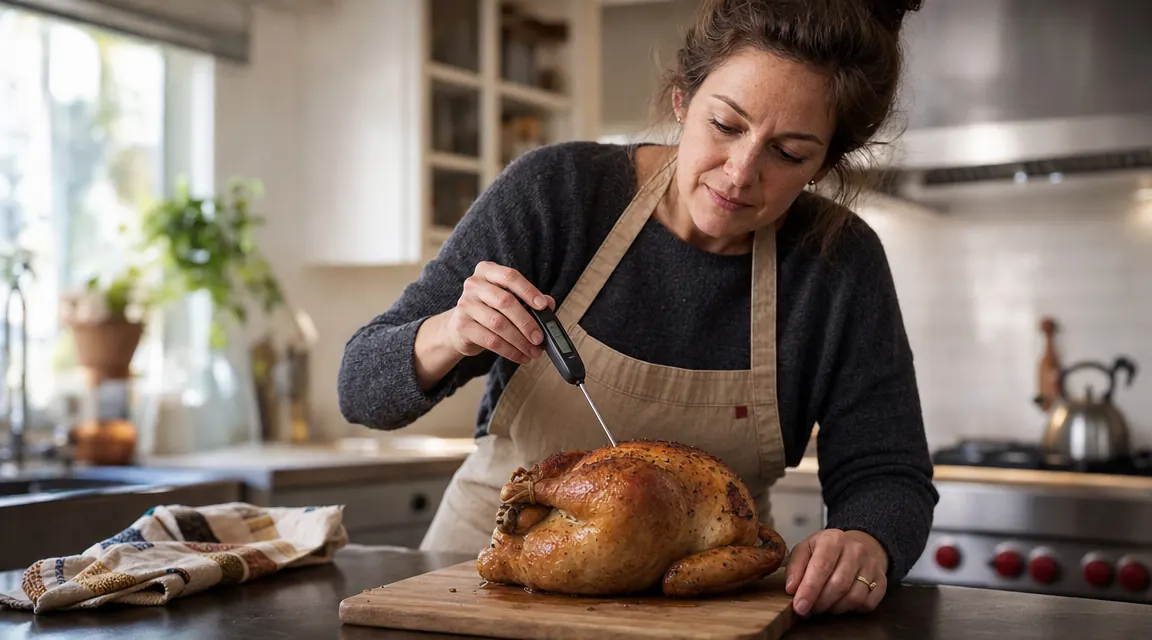
I used to do the thing everyone does. Press the thickest part of the chicken breast with my finger and tell myself it felt done. Cut into a pork chop and stare at the color hoping I'd gotten it right. Some nights I was lucky. Other nights dinner was either rubbery and overcooked because I panicked, or I was sending nervous glances around the table hoping nobody felt sick the next morning. I cooked like that for years before my sister handed me a KIZEN instant read thermometer at a backyard cookout and said, 'just use this, it takes two seconds.' She was right. Two seconds is all it takes, and it changed every dinner after that.
If you've ever cut into chicken to check it, overcooked a pork loin out of caution, or pulled beef off the grill by feel, this guide is for you. Checking internal meat temperature correctly is a five-step skill that takes about a week to become second nature. The KIZEN instant read thermometer is what I keep in my drawer because it's fast enough to use mid-cook, waterproof enough to throw in the dishwasher drawer, and accurate enough that I stopped second-guessing. Let me walk you through every step.
If you're still guessing, this inexpensive tool fixes that tonight.
The KIZEN instant read thermometer reads in 2-3 seconds, folds flat for the drawer, and handles everything from chicken thighs to campfire sausage. Over 77,000 home cooks rated it 4.6 stars. Check today's price before your next grocery run.
Amazon Check Today's Price on Amazon →Step 1: Know Where to Insert the Probe
The single biggest mistake people make with a meat thermometer is probing the wrong spot. Temperature varies by several degrees depending on where you measure, and measuring near a bone, near the surface, or in the thinnest part will give you a false reading every time.
For whole chicken or turkey, insert the probe into the thickest part of the thigh, away from the bone, angled toward the center of the meat. Bone conducts heat faster than meat and will read hotter than the surrounding flesh, making you think the bird is done when the breast meat is still underdone. For chicken breasts on the grill or in a pan, go in from the side rather than the top. Slide the probe horizontally through the middle of the breast so the tip lands at dead center. For steaks and chops, insert from the side, aiming for the geometric center of the cut. For roasts, go straight down from the top at the thickest point, again avoiding contact with any bone.
A quick tip for fish: the flesh is so thin in most fillets that you're reading the thickest part from above, just a short insert. Fish is done at 145 degrees but honestly looks done (opaque and flaking) slightly before that, so I probe once and trust the number.

Step 2: Get the Probe Depth Right
The temperature sensor on the KIZEN is located at the very tip of the probe, not along the shaft. This is actually an advantage over old-style dial thermometers, which read an average along a wide sensor zone. But it does mean placement precision matters. You want the tip sitting in the center of the meat, not poking out the other side and not sitting too shallow near the surface.
For most chicken breasts and pork chops, you're inserting about an inch to an inch and a half. For a thick ribeye or a roast, you may go deeper. A good rule: insert until you feel the tip hit resistance near the center of the cut, then pull back just slightly so you're reading pure meat, not the exterior surface from the other side. The KIZEN probe is slim enough that you won't lose juice making this hole, and it won't leave a visible mark on the cut when it rests.

Step 3: Read the Temperature Correctly
The KIZEN reads in 2-3 seconds. Watch the display and wait for it to stabilize, meaning the number stops climbing. Some people pull the probe too soon and get a reading that is still ticking up, then they wonder why the number they saw was 10 degrees lower than actual. Hold the probe steady for a full three-count after the display appears and make sure the number has settled before you read it.
Also, check a second spot on larger cuts. On a whole chicken, probe the thigh and the breast. On a thick roast, probe two different depths. The lowest reading is the one that matters for food safety. You're cooking to bring the coldest part of the meat up to the target temperature, so if the thigh reads 170 and the breast reads 161, the breast is your controlling reading. Pull the bird when the breast hits 165.
The number on the display doesn't lie. The poke-and-pray method does. Once you start checking temp, you'll wonder how you cooked chicken without it for so long.

Step 4: Know Your Target Temperatures
This is the part that most guides bury at the bottom, but it's the most practical piece of information. Here are the minimum safe internal temperatures from the USDA, along with what they actually mean for the food on your table.
Chicken and poultry: 165 degrees Fahrenheit, no exceptions. This applies to breasts, thighs, drumsticks, ground chicken, and whole birds. Poultry is the one protein where I never chase a lower number. Pull it at 165 and it will be safe and still juicy if you haven't overcooked it on the way there. Ground beef and ground pork: 160 degrees. Whole cuts of beef and pork, including steaks, roasts, and pork chops: 145 degrees minimum, with a three-minute rest. Fish and shellfish: 145 degrees. Lamb: 145 degrees for whole cuts, 160 for ground. Leftovers being reheated: 165 degrees all the way through.
For steak specifically, most home cooks want a result beyond the safety minimum. Medium-rare sits around 130-135 degrees internal. Medium is 140-145 degrees. Well-done is 160 and above. These are preference targets, not safety targets. The KIZEN is precise enough that you can confidently pull a steak at 132 and know exactly what you're getting. That kind of control is what separates a great home cook from someone who just hopes for the best.

Step 5: Rest the Meat and Re-Check if Needed
Resting is not optional, especially for larger cuts. When you pull meat off heat, the carry-over cooking continues. A whole chicken will rise 5-10 degrees during a 10-minute rest. A thick steak will rise 3-5 degrees. If you're targeting 165 for chicken, pulling at 160-162 and resting it tented under foil for 5-10 minutes will bring you right to target without the breast drying out. For steak, pull at 127-130 if you want medium-rare. The rest does the rest of the work.
The KIZEN is IP67 waterproof rated, which means you can probe right through a foil tent without worrying about condensation or splatter hitting the probe. Once the rest period is done, a quick second probe confirms your final internal temperature before you slice. I do this every time I cook a roast or a whole bird, and it has become as automatic as tasting sauce before serving.
What Else Helps
A thermometer is the non-negotiable tool, but a few other habits reinforce accurate results. First, start with meat that isn't ice cold. Pulling chicken straight from the refrigerator and putting it straight onto a screaming-hot pan leads to overcooked exteriors and undercooked centers. Let thick cuts sit at room temperature for 15-20 minutes before cooking. The thermometer will still be the final judge, but even cooking is easier when the meat isn't fighting a 40-degree temperature gradient from the center out.
Second, calibrate your KIZEN if you start doubting it. Fill a glass with ice water, let it sit for a minute, and insert the probe. The reading should be at or very close to 32 degrees Fahrenheit. The KIZEN passed my ice-water test the first time I ran it. Most quality thermometers in this price range do. But it's a good two-second sanity check to do once a month if you're using it heavily. Third, clean the probe between proteins, especially when cooking multiple meats at once. The KIZEN's probe wipes clean in seconds, and because it's waterproof, a quick rinse under the faucet between the chicken check and the sausage check is all you need.
One habit I've built with my kids in the kitchen: I hand them the KIZEN and let them check the temp. It teaches them what a safe number looks like and gets them involved in the actual cooking process rather than just watching. My 11-year-old now asks to check the chicken himself before I plate it. That's a food safety habit he'll carry for life, and it started with an affordable tool that fit in a drawer.
Stop guessing and start checking. The KIZEN takes 2 seconds per cook.
Waterproof, foldable, and accurate to plus or minus 1 degree. The KIZEN instant read thermometer is the most-returned cooking anxiety my drawer has ever fixed. See today's price on Amazon before your next chicken night.
Amazon Check Today's Price on Amazon →